
Patrick Menzel SEO keyword research strategist Phoenix Arizona specializing in buyer-intent keyword filtering for service businesses
Keyword Research for Service Businesses: Why Most Waste $50K on Wrong Keywords
Keyword Research · SEO Strategy · Service Businesses

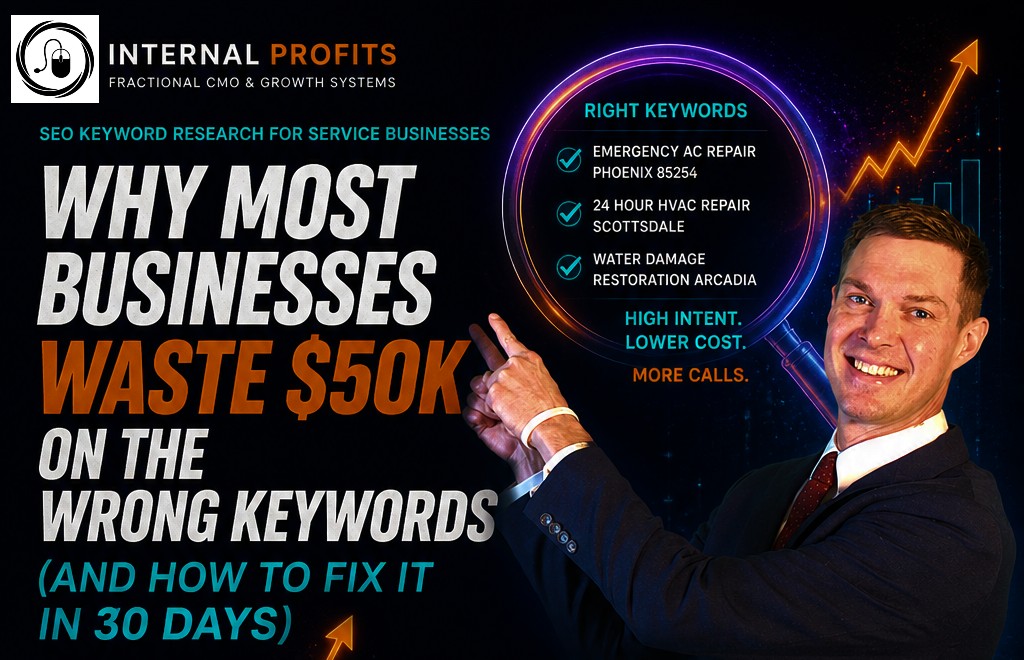
Why Most Businesses Waste $50K on the Wrong Keywords (And How to Fix It in 30 Days)

▲ THE KEYWORD TRAP

Most service businesses pick keywords based on search volume. They target "HVAC repair" (33,000 searches/month) instead of "emergency AC repair Phoenix" (90 searches/month). The high-volume keyword costs $45/click and converts at 2%. The low-volume keyword costs $22/click and converts at 18%. Bad keyword research wastes $50K before you realize the traffic doesn't convert. Smart keyword research finds the 50-100 keywords that actually generate calls — not just website visits.

The 3 Most Expensive Keyword Research Mistakes

Here are the three ways service businesses burn through marketing budgets targeting the wrong keywords:

THE 3 MOST EXPENSIVE KEYWORD RESEARCH MISTAKES
CHASING HIGH
SEARCH VOLUME
You pay $38+/click for traffic that won't call
ANNUAL WASTE
$35K–$60K
TARGETING GENERIC
SERVICE KEYWORDS
You get browsers, not buyers. Miss high-intent calls
REVENUE LOST
$18K–$35K
NO KEYWORD
FILTERING
You waste 6–12 months on the wrong terms
TIME & MONEY LOST
6–12 MONTHS
Mistake #1: Chasing High Search Volume

You target "plumbing" (90,000 searches/month) because the volume looks impressive. Problem: 85% of those searches are informational ("how plumbing works", "plumbing diagram"), not buyers. You're betting your ad budget on Google's guess about what searchers want. You shouldn't risk revenue on an algorithm's interpretation. You're paying $38/click for traffic that won't call.

Annual Waste
$35,000-$60,000 in Google Ads spend on non-converting traffic
Mistake #2: Targeting Generic Service Keywords

You target "HVAC company" instead of "emergency AC repair Scottsdale". The generic keyword brings 1,000 visitors who are comparison shopping across 20 companies. The specific keyword brings 40 visitors who need help TODAY and will call the first result.

Revenue Lost
$18,000-$35,000/year in missed high-intent leads
Mistake #3: No Keyword Filtering or Quality Control

Your agency gives you a 500-keyword CSV file with zero filtering. It includes expensive keywords you'll never rank for, DIY keywords from people avoiding contractors, and irrelevant terms that waste budget. Nobody filtered for buyer intent, cost-per-click, or conversion likelihood.

Time & Money Lost
6-12 months targeting wrong keywords before you realize the strategy failed

The pattern: All three mistakes prioritize volume over intent. More traffic doesn't mean more revenue. The right 50 keywords will outperform 500 wrong keywords every time.

The Search Volume Trap (And Why Low-Volume Keywords Win)

Here's what every keyword research tool shows you: search volume. And here's what most businesses do: sort by volume, pick the biggest numbers, and target those keywords. This is how you waste money.

Example: HVAC Contractor in Phoenix

📊 HIGH-VOLUME VS. LOW-VOLUME KEYWORD COMPARISON
High-Volume Keyword: "HVAC repair" (33,100 searches/month)
Cost-per-click: $42-$58
Conversion rate: 1.8%
Why it fails: Too generic. Includes people in Alaska, people researching DIY repairs, people just browsing.
Low-Volume Keyword: "emergency AC repair Phoenix 85254" (90 searches/month)
Cost-per-click: $22-$28
Conversion rate: 18-22%
Why it wins: Hyper-specific. Someone in that exact zip code with an emergency need will call the first result they see.
💰 THE MATH

"HVAC repair" at $50/click and 1.8% conversion = $2,778 cost-per-lead. "Emergency AC repair Phoenix 85254" at $25/click and 20% conversion = $125 cost-per-lead. One keyword is 22x more expensive per lead than the other.

Why this matters for service businesses: You don't need 10,000 monthly visitors. You need 100 visitors who actually call. Targeting the right low-volume, high-intent keywords is how you get there.

Why Copying Your Competitor's Keywords Costs You Money

Most keyword research starts with competitive analysis: "What keywords is my competitor ranking for? Let's target those."

The Problem with This Approach:

Your competitor might be targeting the wrong keywords (and losing money doing it). Your competitor might have a $100K/year SEO budget you don't have. Your competitor might be ranking for informational keywords that don't convert. Moreover, copying their keywords puts you in direct competition on their strongest terms.

The smarter approach: Find keyword gaps — terms your competitors AREN'T ranking for that have buyer intent. Emergency services, specific neighborhoods, niche specialties, unique service combinations.

💡 REAL CASE STUDY

Restoration company stopped targeting the same 20 keywords every competitor was fighting for. We found 50 neighborhood-specific + service-type combinations nobody was ranking for ("water damage restoration Arcadia Phoenix", "emergency flood cleanup Paradise Valley"). Traffic dropped 40%. Inbound calls increased 85%. Lower traffic, higher revenue.

Example: Every HVAC company in Phoenix is fighting for "AC repair Phoenix". Nobody is ranking for "commercial HVAC repair Tempe 85281" or "24-hour emergency air handler replacement Phoenix". Those gaps are your opportunity.

The Keyword Filter System (How We Find the 50-100 Keywords That Matter)

Our keyword research process for service businesses isn't about generating a 500-keyword list. It's about filtering down to the 50-100 keywords that will actually generate calls.

Here's what we filter for:

OUR KEYWORD FILTER SYSTEM
🎯
BUYER INTENT
(Not Informational)
💰
CPC BUDGET
ALIGNMENT
Affordable CPCs
📍
GEOGRAPHIC
RELEVANCE
Local targeting
🔧
SERVICE-SPECIFIC
MATCH
Your services only
COMPETITION LEVEL
VS. DOMAIN AUTHORITY
Winnable keywords
1
Buyer Intent (Not Informational Intent)
We eliminate keywords where the search intent is research, not hiring. "How to fix AC" gets filtered out. "Emergency AC repair near me" stays in.
2
Cost-Per-Click Budget Alignment
If a keyword costs $75/click and your max CPC budget is $35, we filter it out. No point targeting keywords you can't afford to compete on.
3
Geographic Relevance
We filter out broad national keywords and focus on city + neighborhood + zip code combinations where you actually service customers.
4
Service-Specific Match
If you don't offer a service, we filter those keywords out. A residential HVAC company shouldn't target "commercial chiller repair" just because it has search volume.
5
Competition Level vs. Domain Authority
If you're a new website competing against 10-year-old competitors with 500+ backlinks, we filter out their strongest keywords and focus on gaps you can actually win.

The output: A CSV file with 50-100 filtered keywords split into three buckets (awareness, consideration, buyer-intent), complete with search volume, estimated CPC, competition level, and recommended usage (SEO blog, Google Ads, service page). Plus a Negative Keyword List — terms to exclude in Google Ads (like "jobs", "salary", "school", "free", "DIY") so you don't waste budget on traffic that will never convert.

Our Keyword Research Process for Service Businesses

Here's exactly how we execute keyword research for HVAC, contractors, restoration, and other service businesses:

1
Discovery Call (30-45 minutes)
Understand your services, service areas, ideal customers, pricing, and competitive landscape. Clarify which services generate the most revenue (so we prioritize those keywords).
2
Raw Keyword Generation (500-1,000 keywords)
Pull keywords from Ahrefs, SEMrush, Google Keyword Planner, and competitor analysis. Cast a wide net initially — we'll filter down to what matters.
3
Keyword Filtering (Down to 50-100 keywords)
Apply the 5-filter system: buyer intent, CPC alignment, geographic relevance, service match, competition level. Remove DIY keywords, informational keywords, and terms outside your budget.
4
3-Bucket Categorization
Sort keywords into awareness (traffic), consideration (engagement), and buyer-intent (revenue) buckets. Assign each keyword a recommended use case (SEO blog, Google Ads, service page, Google Business Profile).
📊 3-BUCKET EXAMPLE: HVAC CONTRACTOR
AWARENESS "Why is my AC leaking water?"
CONSIDERATION "Best AC repair companies Phoenix"
BUYER-INTENT "24-hour emergency AC repair 85001"

Each bucket serves a different purpose: awareness builds traffic, consideration builds trust, buyer-intent drives revenue.

5
Google Ads Budget Estimation
Calculate estimated monthly ad spend needed to compete for your target keywords. Show cost-per-click ranges and projected monthly budgets for PPC campaigns.
6
Competitor Analysis & Gap Identification
Identify which keywords your competitors are ranking for (and which they're missing). Highlight keyword gaps where you can win without fighting established players.
7
Deliverable: Filtered Keyword Report (CSV + Strategy Call)
Receive a CSV file with 50-100 filtered keywords, categorized by bucket, with search volume, CPC estimates, and usage recommendations. 30-minute follow-up call to explain the strategy and answer questions.

Timeline: 7-10 days from discovery call to final deliverable.

💰 PRICING

$349 (1 service/product), $699 (2 services), $999 (3 services). Additional keyword filtering available at $0.25/keyword for lists over 500 terms.


★ KEY TAKEAWAY
Most service businesses waste $35K-$60K/year targeting high-volume keywords that don't convert. The keyword research trap is sorting by search volume and picking the biggest numbers. Smart keyword research filters 500-1,000 raw keywords down to the 50-100 that actually generate calls: buyer-intent keywords with geographic specificity, budget-aligned cost-per-click, and competition gaps you can actually win. Proper keyword filtering is the foundation of cost-effective SEO and Google Ads — without it, you're burning money on traffic that won't call.

Need Keywords That Actually Convert?

We research, filter, and categorize 50-100 revenue-generating keywords for service businesses. Buyer-intent focus, 3-bucket framework, Google Ads budget estimates included.

Book Keyword Research Call →
ABOUT THE AUTHOR
Patrick Menzel SEO keyword research strategist Phoenix Arizona specializing in buyer-intent keyword filtering for service businesses
Patrick Menzel
SEO & Keyword Research Strategist

Owner & Fractional CMO at Internal Profits. 15+ years building keyword strategies for service businesses. Every keyword filtered for buyer intent and budget alignment. No 500-keyword dumps — just the 50-100 terms that actually generate calls.