
The $50K Burn Rate Mistake (And What to Do Instead)
Here's what most funded startups do in the first 30 days post-close:
- Logo redesign + brand guidelines $12K
- Website refresh (no conversion strategy) $18K
- Social media manager + content calendar $8K
- Brand photoshoot + video assets $7K
- PR agency retainer (no media list) $10K
- SEO keyword research + technical audit $3K
- Google Ads campaign (3 campaigns live) $8K
- Press release + media list (50 outlets) $4K
- Sales automation (CRM + AI workflows) $6K
- CallRail tracking + attribution setup $2K
The difference: One approach optimizes for investor updates ("we launched our rebrand!"). The other optimizes for revenue ("we acquired 40 inbound leads and closed 3 pilot customers").
AI healthcare SaaS client (Onpoint Healthcare Partners) raised Series A. Skipped the brand agency. Invested $25K in SEO + Google Ads + PR in month 1. Went from 0% to 9% Google market share in 90 days — outranking Microsoft DAX Nuance (medical AI scribe) and Amazon HealthScribe for target keywords. Even in the AI healthcare space, buyers search Google and read reviews before buying. Direct search visibility + testimonial credibility = faster sales cycles. Series C funded 18 months later. The brand polish came in year 2 after revenue validated product-market fit.
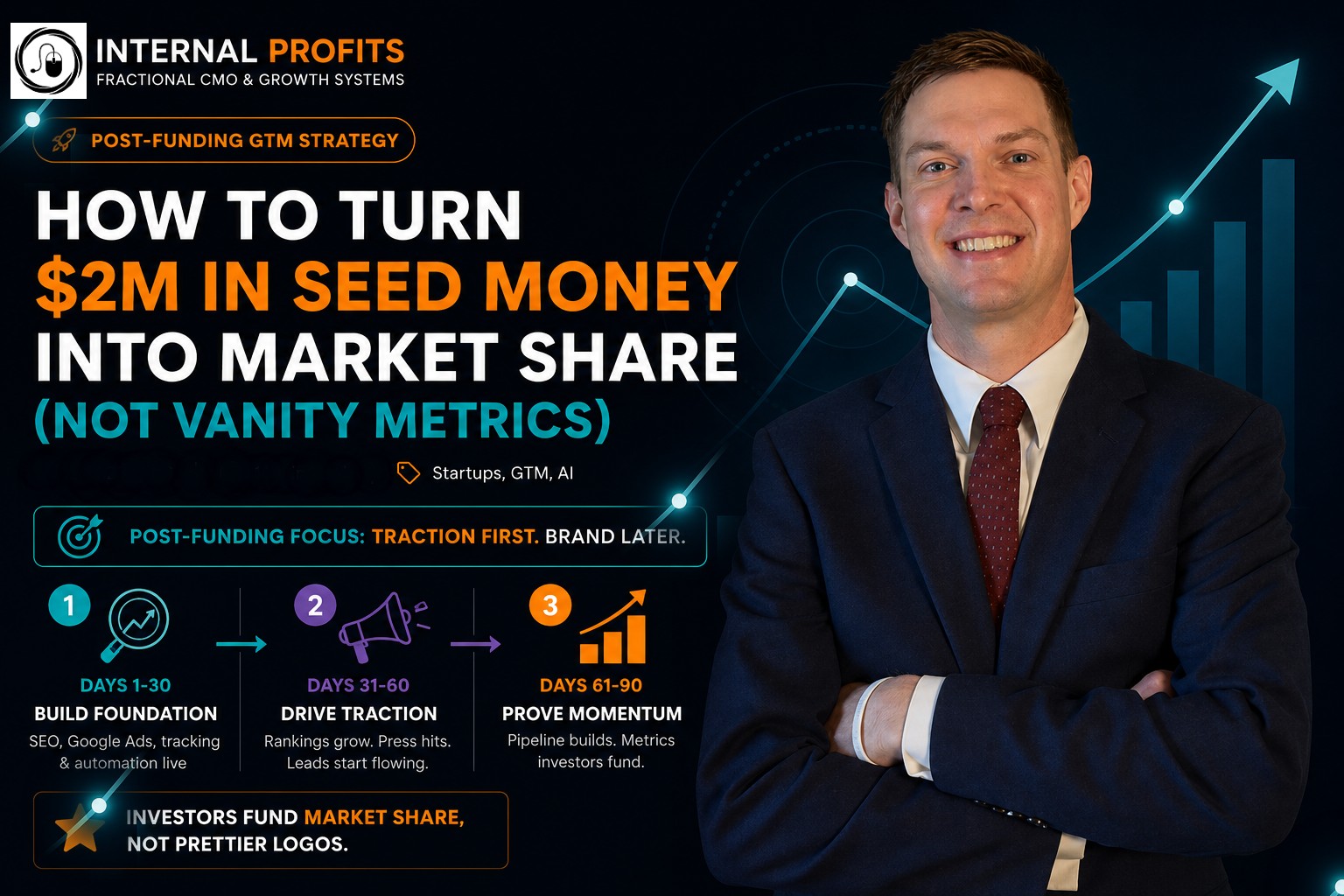
The 90-Day Post-Funding GTM Framework
Here's the execution playbook for funded startups who need traction in 90 days — not 18 months:
The 90-day outcome: Traction metrics investors actually care about. Not a prettier logo.
Fast Google Market Share (Not Brand Awareness)
Brand awareness is what agencies sell when they don't know how to generate revenue. Google market share is measurable. Trackable. Directly tied to inbound pipeline.
Here's what "fast Google market share" actually means:
Month 1: Technical Foundation + Keyword Validation
SEO audit completed. Target keywords researched (50-100 terms across TOFU/MOFU/BOFU intent). Google Ads campaigns test which keywords actually convert. You're not guessing anymore — you have data showing "AI workflow automation" converts at $180/lead while "AI productivity tools" is $520/lead.
Month 2: Content + Rankings Begin
4-6 blog posts published targeting validated keywords from Google Ads. First weak rankings appear (page 2-3 for long-tail terms). Google Business Profile optimized and posting weekly. Press coverage starts driving referral traffic and backlinks.
Month 3: Market Share Acceleration
5-15 keywords ranking page 1. Organic traffic climbs from 50 visits/week to 200-400 visits/week. Google Ads CPC drops 20-30% as Quality Score improves from SEO authority. You're now visible for category searches that matter.
Investors don't fund brand guidelines. They fund market share. When you can show "we went from 0% to 9% Google market share for 'AI healthcare automation' in 90 days" — that's a traction metric that justifies Series B. A redesigned logo isn't.
Press & Media: Building Category Authority
Most funded startups hire a PR agency and get zero results. Here's why: PR agencies pitch their client roster to the same 50 journalists. You're competing with 30 other startups for the same TechCrunch byline.
Smart GTM strategy builds a custom media list and pitches category authority — not product launches.
What We Build (Month 1):
Targeted media list (50-100 journalists covering your category)
Monthly press release (not product announcements — thought leadership angles)
Pitch angles that journalists actually want (data, trends, contrarian takes)
What Gets Published (Months 2-3):
3-8 press placements (TechCrunch, VentureBeat, Forbes, industry trades)
Backlinks that boost SEO domain authority
Referral traffic from media sites to your website (tracked with UTMs)
Social proof for investor updates and sales decks
The goal isn't vanity coverage. The goal is category positioning that makes inbound sales easier. When a prospect Googles your CEO's name and sees 5 media mentions, trust accelerates.
Sales Automation That Converts Inbound Into Pipeline
You're about to generate 50-150 inbound leads in 90 days from SEO, Google Ads, and PR. If you don't have automation handling qualification, follow-up, and nurture, 70% of those leads die in your inbox.
Here's the sales automation stack we build for funded startups:
1. Lead Capture + Source Attribution
Every form fill, every phone call, every chat message is captured in your CRM with full attribution (which keyword, which campaign, which page). You'll know exactly which $1 of marketing spend generated which lead.
2. AI Lead Qualification
AI agent texts new leads within 60 seconds, asks qualifying questions (budget, timeline, decision authority), scores the lead, and routes high-intent prospects to sales. Low-intent leads enter automated nurture.
3. Missed Call Text-Back
Inbound call goes to voicemail? AI texts them back in under 90 seconds with a meeting scheduler link. Conversion rate on missed calls jumps 30-40%.
4. Automated Nurture Sequences
Leads who aren't ready to buy enter a 30-90 day email + SMS nurture sequence. Educational content, case studies, product updates — all automated based on lead score and behavior.
The outcome: Your sales team only talks to qualified, high-intent leads. Everything else is handled by automation.
Your Existing Tech Stack, Supercharged
We don't rip out your existing tools. We make them work together.
Our GTM system integrates with your current infrastructure — whether you're running on HubSpot, Salesforce, Pipedrive, or custom-built systems. The sales automation layer sits on top of your existing CRM, not in place of it. We connect the dots between your marketing tools, sales tools, and data sources so everything feeds into one unified pipeline.
What We Integrate:
CRM Systems: HubSpot, Salesforce, Pipedrive, Close, Copper
Marketing Tools: Google Ads, Google Analytics, Google Search Console, CallRail
Automation Platforms: Zapier, Make, native API integrations
Communication: Twilio (SMS), SendGrid (email), Slack (internal alerts)
Attribution: UTM tracking, CallRail call tracking, multi-touch attribution
The result: Every lead source is tracked. Every conversion is attributed. Every dollar is accounted for. You're not replacing your tech stack — you're unlocking its full potential.
Who This GTM System Is Built For
This isn't for everyone. It's built for funded startups that need traction in 90 days — not 18 months.
This is NOT For:
Pre-revenue startups still validating product-market fit (you need customers, not marketing). Consumer apps where SEO doesn't drive acquisition (you need virality + paid social, not Google). Companies where buyers don't search Google (enterprise procurement, government contracts). Founders who want to "build brand" before generating revenue (hire a brand agency instead).
This GTM execution tier starts at $8,499/mo (Startup/Pro tier) and scales to $39,999/mo (Series B+ tier). This is not your $2,000/mo service business SEO package. This is full-stack GTM for funded companies with aggressive timelines and investor expectations.