
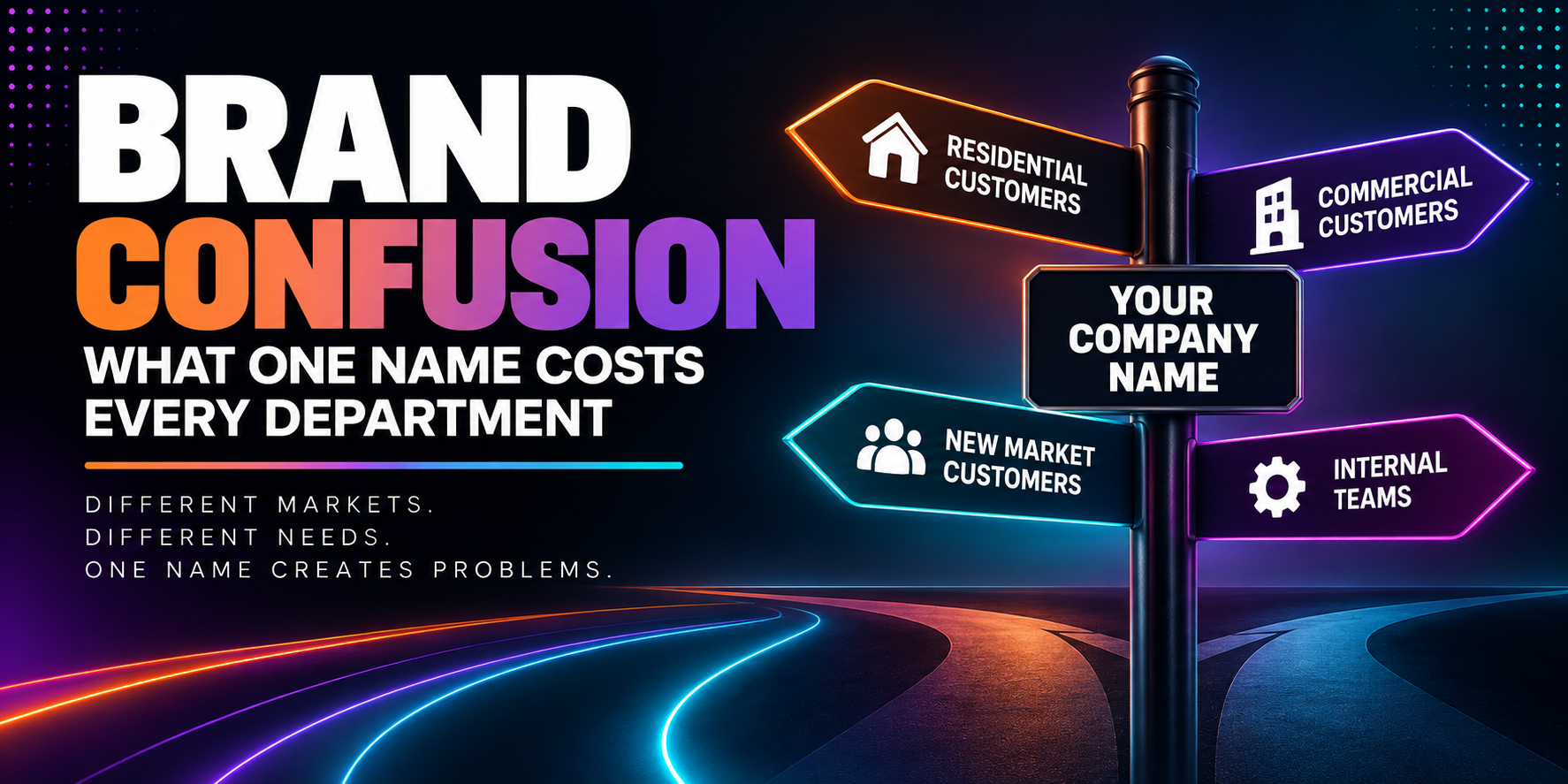
Your Company Outgrew Its Name
A property group puts three buildings out for bid. You can do the work. You look at the RFP, you look at your own name, and you decide not to bid.
Nobody in that room calls it brand confusion. You call it "we're not really set up for that side."
Be clear about what happened, because the usual framing gets it backwards. The name was not a mistake. You chose it for a market, it worked in that market for fifteen years, and it still does. Nobody founding a company plans the second one. What changed is the company, not the name. You outgrew the job you originally hired that name to do.
From there it moves in a predictable order:
The name, the site, the phone greeting and the reviews are all built for a single buyer. Everything is coherent because it only has one job.
A job goes well, then another. Nobody names a division for what is currently four percent of revenue, so the existing name absorbs it.
One homepage now addresses two buyers, so the headline gets general enough to fit both. Generality is the first visible cost.
Sales improvises. Dispatch triages by volume. Hiring screens out the wrong people. Billing runs one process against two payment cultures.
Each buyer reads a company that is partly for someone else. This is the point most people mean when they say brand confusion.
The newer market costs more to win and closes slower. You conclude that market is competitive. It is, but that is not what is happening.
Brand confusion is what a customer experiences at step five. By then four internal steps have already happened, and each one was absorbed by a department that had its own explanation for it. The conversation almost never starts until growth stalls, which is two steps too late.
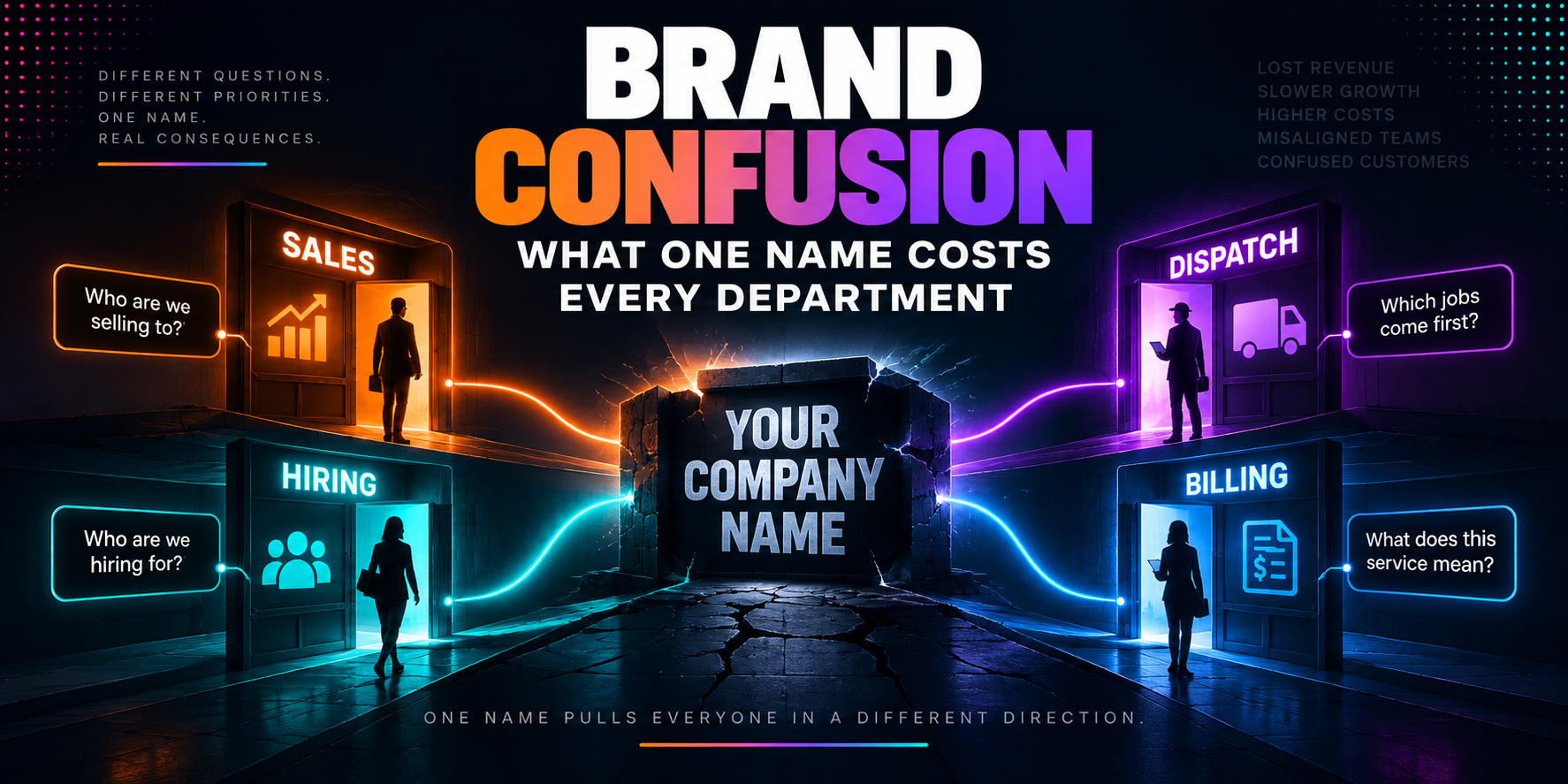
How Four Departments Compensate
Step four is where brand confusion gets expensive and nobody is looking. Read the right-hand box on each card. Every one of those sentences has been said inside a company this year.
One deck for two buyers. A property manager needs bonding, scheduling windows and a maintenance agreement. A homeowner needs a price and a date. The rep improvises, and win rates drift apart with nobody able to say why.
Contract work runs on scheduled windows. Residential runs on same-day urgency. One board, one brand, so the dispatcher triages by whoever called loudest. The contract work loses, because the homeowner is angrier.
Two kinds of tech want two different jobs. Your careers page describes one company doing both, so applicants self-select wrong and the ones you hire leave inside a year when the work is not what the brand implied.
Homeowners pay on completion. Commercial pays on terms, against a PO, through a portal. One accounts receivable process serves both, and it was designed around whichever customer came first.
Four departments, four reasonable explanations, and not one of them points at the name. Brand confusion stays expensive because it is always someone else's problem first.
The Half-Built Second Brand
The most common response to a brand confusion diagnosis: we already have two brands.
Usually true. Usually about forty percent finished.
A market came up, the name did not fit, and someone registered a domain over a weekend. A logo followed. Then the quarter got busy. Three years later that second name exists in some of the places it needs to exist, and the gap costs more than one name ever did.
Five tells that yours is half-built
- A domain but no phone number of its own. Every call lands on the same line, so you cannot tell which identity produced it, which means it cannot be defended at budget time.
- The site says one name, the email says another. Anyone paying attention sees the seam in the first reply.
- It is a page, not a site. A "Commercial Services" section under the residential brand is a tab, not an identity.
- No Google Business Profile of its own. It cannot appear in local results for the new market, which is where that market looks.
- Nobody knows how to answer the phone. Ask three people which name they use. Three answers means it exists on paper only.
You pay for two identities and collect the benefit of one. The new market sees a name with nothing behind it, which reads as less established than your original name did. And because the second brand has no separate tracking, you cannot prove it earned anything, so it never gets the investment that would finish it. That loop is where most second brands die.
Three Ways Out, And Who Each One Is For
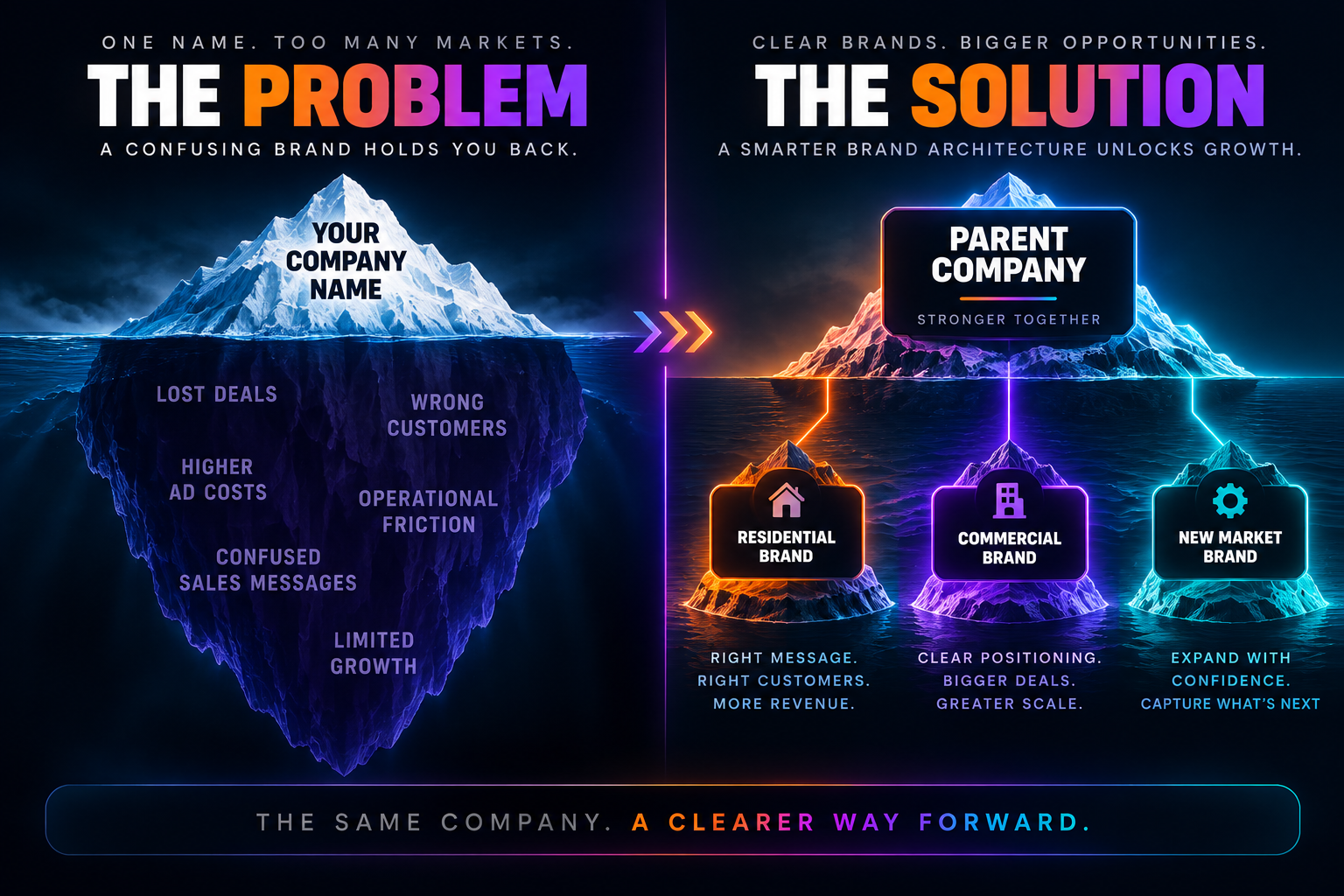
Most owners assume the only fix is renaming the company, price that out once, and stop. There are three, and two of them never touch the business you built.
Changes: everything. Entity, licensing, insurance, payroll, site, number, team. Timeline: quarters. The trap: owners pick this because it sounds like the real answer, then run two back offices with one back office worth of staff.
Changes: the market-facing identity only. Its own name, domain, number, site and profile, operating as a division underneath. Stays: entity, contracts, licensing, insurance, payroll, crews. Timeline: weeks. The trap: stopping at the domain.
Changes: almost nothing structural. A consumer-facing name with its own domain, number and landing pages routing back to the business you run. Timeline: fastest. The trap: running it so lightly it never gets the budget to prove anything either way.
Coca-Cola owns Sprite, Fanta and Dasani. They never named them Coca-Cola Lemon-Lime, Coca-Cola Orange or Coca-Cola Water. Same company, same trucks, same shelf relationships, different name on the bottle. They own the most valuable name in the category and still refused to stretch it into a market it was not built for. That is option two, at scale.
Your legal company name exists for legal and administrative purposes. Your marketing brand exists to communicate with customers. Those two jobs do not always belong to the same name, and businesses commonly operate under DBAs, trade names, or campaign brands. Business-name registration, assumed-name and DBA requirements, and related rules vary by state and circumstance. This article is a marketing discussion, not legal advice. Confirm the requirements with the appropriate state and local authorities or qualified legal counsel before you file anything.
What a Second Identity Costs To Build
Most owners never get the price of fixing brand confusion, because it gets quoted as a project rather than parts. Here it is in pieces, at our published rates.
The logo is the cheapest part. The weight sits in the website, the messaging and the keyword work, because those are what make a new name findable and credible. A name with no site and no search footprint is a domain, not a brand.
The largest cost is not in the table. It is the twelve to eighteen months a brand new name spends with no reviews, no rankings and no recognition. That gap is why second brands stall, and why some buyers acquire an established name instead of building one. Building is slower and cheaper. Buying is faster and not.
Measure It Separately Or You Will Never Know
One discipline separates a real fix for brand confusion from a vanity project. Give the new identity its own number and its own landing pages, then route everything back to the line your team already answers. Every call, form and booking now carries the identity that produced it, and call tracking and attribution turns the question into arithmetic.
Without that split you are guessing. With it, you can prove inside one quarter whether separating the identities changed anything. If it did not, you learned something cheap. If it did, you now know what the stretched name was costing you every year you ran it.
Plenty of companies should stay under one name. If both markets buy for the same reason, from the same kind of person, on the same terms, one identity is simpler and cheaper to run. The test is not how many services you sell. It is whether the two buyers resemble each other.
There is a market you want. There is a name that was built for a different one. Maybe there is a second name already sitting half-finished in a folder. So what are you doing with it? Renaming the company is one answer, and it is the one almost nobody needs.
If you want to work out which of the three routes fits, we are happy to look at it with you. Book a 45-minute strategy session, read the case studies, or call 866-TRACK-SALES (866-872-2572).