
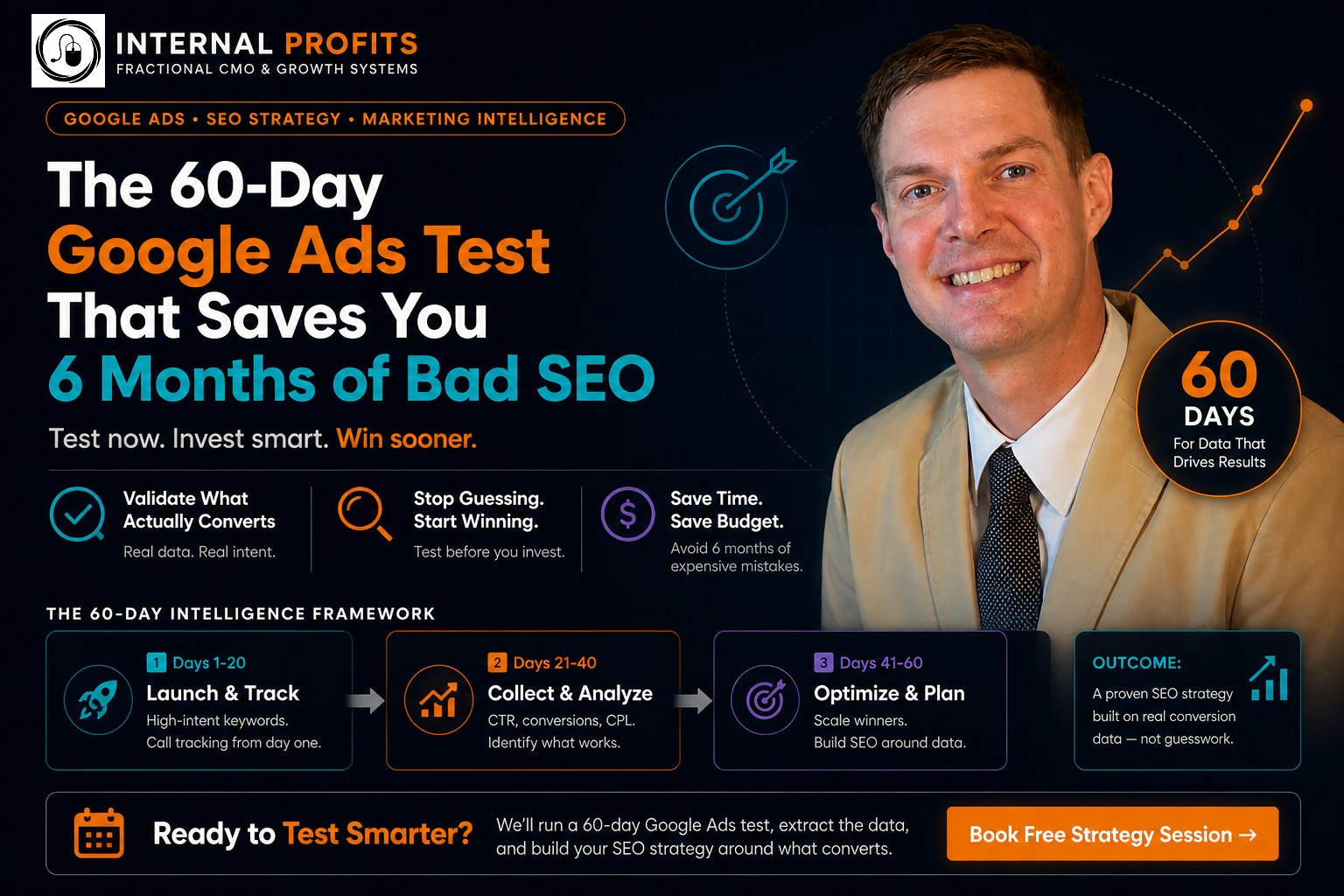
The Expensive Problem With SEO-First Strategies
Here's what happens when businesses commit to SEO without testing first.
You hire an agency or consultant. They audit your site. They recommend a content strategy targeting 20-30 keywords. You pay for blog posts, service page rewrites, and technical optimization. Six months later, you're ranking — but the phone isn't ringing.
Why? Because the keywords you targeted don't convert. They drive traffic, but not buyers.
The fundamental problem is this. SEO takes 4-9 months to deliver meaningful results. That's 4-9 months before you know if your keyword strategy was right. If you chose wrong, you've burned half a year and $15K-$30K on content that doesn't drive revenue.
Moreover, search intent is tricky. A keyword might have high volume and low competition — the "perfect" SEO target — but if it attracts researchers instead of buyers, your conversion rate tanks. You won't discover that until months after you've already built the content.
There's a smarter way. Use Google Ads as an intelligence tool first. Test keyword intent and conversion potential in 60 days. Then commit to SEO with confidence.
Google Ads as an Intelligence Tool
Most businesses treat Google Ads and SEO as separate channels. Ads for quick leads. SEO for long-term traffic. That misses the point.
The real value of Google Ads isn't just lead generation. It's market intelligence. Google Ads tells you which keywords convert, what messaging resonates, and what your actual cost-per-acquisition looks like — in weeks, not months.
Think of it this way. SEO is a long-term investment in content and authority. You're committing resources to rank for specific keywords based on assumptions about what your market wants. Google Ads lets you test those assumptions fast and cheap before you commit.
Stop thinking of Google Ads as a lead generation tactic. Start thinking of it as a research tool that happens to generate leads while it gathers data. The leads are a bonus. The intelligence is the real ROI.
This approach flips the typical marketing sequence. Instead of building an SEO strategy based on keyword research tools and gut instinct, you build it on actual conversion data from real buyers clicking real ads.
The 60-Day Test Framework
Here's how the test works in practice.
Week 1-2: Campaign Setup
Launch search campaigns targeting 3-5 core service areas. Keep it tight. You're not trying to dominate every keyword. You're testing intent.
For each service, target 10-15 high-intent keywords. "Emergency HVAC repair," "commercial roofing contractor," "water damage restoration near me." These are buyers, not researchers.
Additionally, deploy call tracking attribution from day one. Every click, every call, every form submission gets tracked to the keyword that drove it.
Week 3-6: Data Collection
Let the campaigns run. Monitor daily, but don't make big changes yet. You need volume to draw conclusions.
Track three metrics obsessively: click-through rate, conversion rate, and cost-per-lead. These tell you keyword intent, landing page effectiveness, and whether the economics work.
Some keywords will convert at 12-18%. Others at 2-4%. The difference isn't random — it's intent. The 12% keywords are buyers. The 2% keywords are tire-kickers.
Week 7-8: Analysis & Optimization
Now you have enough data to make strategic decisions. Kill underperforming keywords. Double down on winners. Test new ad copy based on what's working.
This is where the intelligence emerges. You'll see patterns. Certain phrases convert better. Certain service angles resonate. Certain geographic areas drive higher-quality leads.
What Data You Actually Get
After 60 days of a properly-run test campaign, you'll have answers to the questions that matter most for SEO strategy.
Which Keywords Actually Convert
Not all keywords are created equal. "HVAC repair" and "emergency HVAC repair" target the same service, but one converts at 14% and the other at 4%. The difference is urgency.
Google Ads shows you which keywords drive calls and form submissions. That tells you exactly which keywords to target with SEO content. No guessing. No hoping. Just data.
What Messaging Resonates
Your ad copy is a messaging laboratory. Test headlines, value propositions, and calls-to-action. The winners become your SEO content strategy.
If "same-day emergency service" drives 40% more clicks than "24/7 availability," that headline goes in your meta descriptions, H1 tags, and content strategy. You're not inventing messaging — you're amplifying what already works.
What Your Real Cost-Per-Lead Is
SEO agencies love to talk about "traffic growth" and "ranking improvements." That's vanity metrics. What matters is cost per lead.
Google Ads tells you exactly what it costs to acquire a lead in your market. If your average cost-per-lead is $180, and your close rate is 25%, you know your customer acquisition cost is $720. That context makes every SEO decision smarter.
Which Geographic Areas Are Profitable
Not all locations convert equally. A 10-mile radius might drive profitable leads while traffic from 30 miles out burns budget.
This geographic data informs your local SEO strategy. You build service area pages around cities that actually convert instead of targeting everywhere and converting nowhere.
The goal isn't just to "get traffic." It's to get traffic that converts into revenue. Google Ads tells you which keywords do that. SEO scales it long-term. Trying to do SEO without this intelligence is like building a house without blueprints.
Building SEO Strategy From Ads Data
Once you have 60 days of conversion data, your SEO strategy writes itself.
Content Priorities Based on Conversion Data
Your highest-converting keywords become your highest-priority content targets. If "emergency water extraction" converts at 16% and costs $85 per lead, that's your top SEO keyword. You build service pages, blog content, and case studies around it.
Keywords that drove high traffic but low conversions? Deprioritize them. They're not bad keywords — they're just not buyer-intent keywords for your business. Save your content budget for what actually works.
Landing Page Templates From Winning Ads
Your best-performing ad copy becomes your landing page template. Headline structure, value proposition order, CTA placement — everything that drove conversions in ads gets replicated in your SEO pages.
This is how you avoid the "high traffic, low conversion" trap. Your SEO pages are pre-validated. You already know the messaging works because it's been tested in the most competitive environment possible: paid search.
Geographic Targeting Based on Lead Quality
If your ads data shows that 70% of profitable leads come from three specific cities, your local SEO strategy focuses there first. You create dedicated service area pages, build location-specific content, and pursue local citations in those markets.
This is dramatically more efficient than the typical "target everywhere" approach. You're concentrating resources where the ROI is proven.
Traditional SEO-first: 6-12 months before you know if your keyword strategy works. Google Ads test-first: 60 days to validate strategy, then 6-12 months executing with confidence. Same timeline. Massively lower risk.
Content Topics From Search Query Reports
Google Ads search query reports show you exactly what phrases people type before clicking your ads. These aren't keyword research tool suggestions — they're real buyer questions.
Use these to build your content calendar. If you see 40 searches for "how long does emergency water extraction take," that becomes a blog post. If "commercial vs residential HVAC" shows up repeatedly, that's an FAQ page.
This approach creates content that answers real buyer questions instead of content that targets theoretical keywords. The difference in engagement and conversion is massive.