
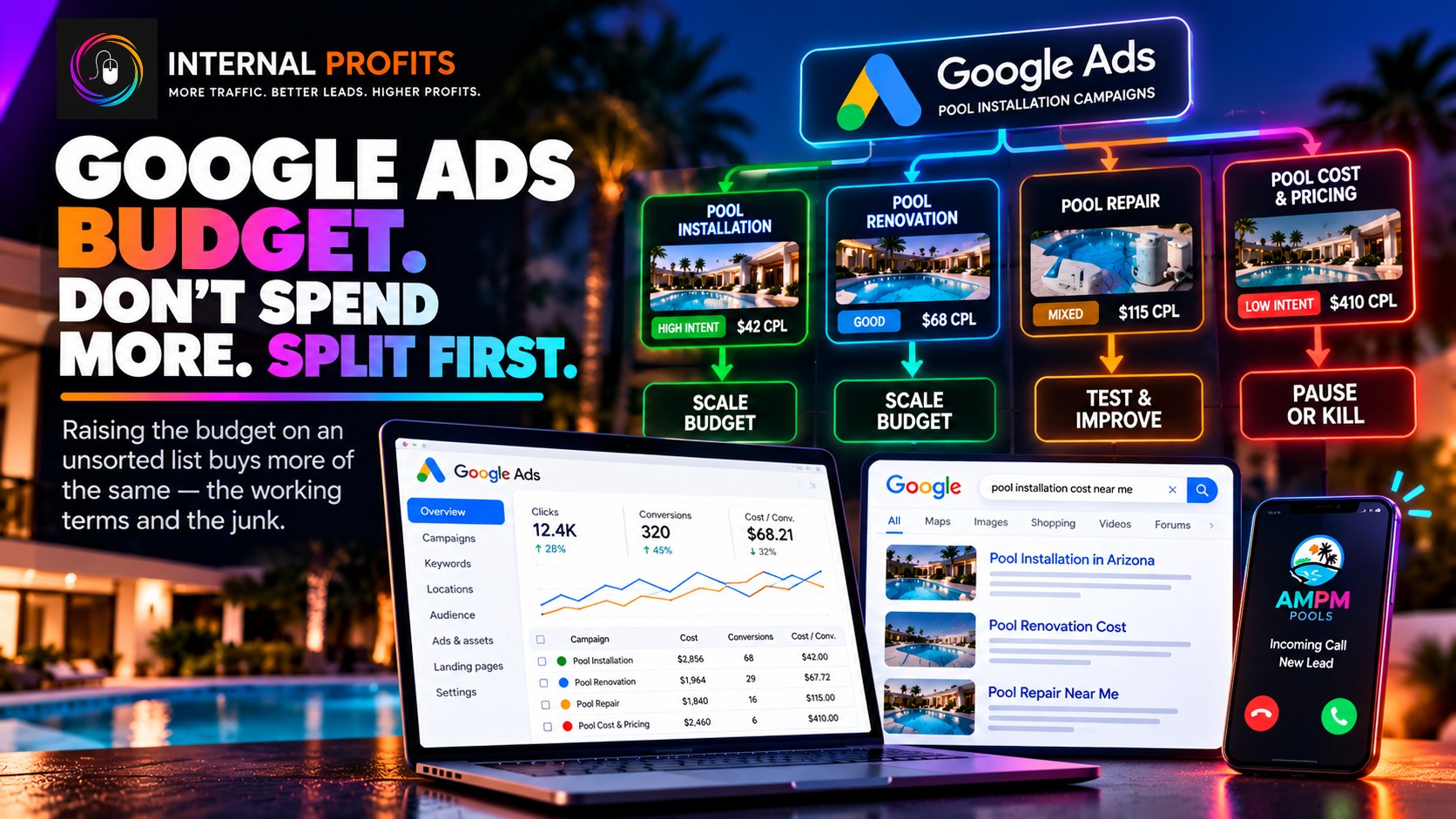
Here is the version of this that plays out most often.
A service business runs Google Ads for a quarter. Leads come in. Some of them are junk. The cost per lead looks survivable, so the owner raises the budget.
The next month costs twice as much. It does not produce twice the work. Often it produces the same amount of work and more junk.
Nothing broke. The budget just multiplied a list that was never sorted, so it bought more of the failing terms alongside the working ones.
The Month You Doubled the Google Ads Budget
A single blended cost per lead is an average, and averages hide the thing you need to see.
Say the account reports $180 per lead. That number can describe two very different accounts.
That is the case for splitting the list before the Google Ads budget goes up, not after. We wrote about the expensive version of this lesson in why most businesses waste $50K on the wrong keywords.
Your Google Ads Budget Is Not a Keyword List
These get treated as the same job. They are not.
Keyword research builds the list. Deciding how the Google Ads budget is divided across it is a separate job, and it is the one that gets skipped. Research asks what people search. Segmentation asks which groups deserve their own budget, their own page and their own verdict.
We sort by funnel stage in the 3-bucket keyword research framework, and by destination page in SEO website keywords. This article is about the cuts you make after those two, the ones that decide where money goes.
The Five Cuts That Actually Change the Numbers
Most accounts are segmented one way, by service. That is the least informative cut available. Five others move the numbers more.
"AC not cooling" and "AC maintenance plan" are the same service and completely different buyers. One books today at almost any price. One is shopping. Blending them makes the urgent traffic look expensive and the browsing traffic look efficient.
Phoenix is not one market. Drive time, home age, and average ticket vary by suburb. A segment that loses across the metro often wins in three zip codes and loses badly in twelve.
A $220 service call and a $14,000 system replacement should never share a cost-per-lead target. Segment by the job the search implies, then judge each segment against what that job is worth.
Homeowner, renter, property manager, general contractor. Same words, different authority to say yes. Property manager traffic often costs more per lead and is worth more per customer.
A lead at 2pm on Tuesday gets answered. The same lead at 9pm Saturday may not. That is not a keyword problem, but it shows up in the keyword numbers and gets blamed on the term.
The search terms report is where most of these cuts get discovered, because it shows the phrase the person typed rather than the keyword you bought.
What Makes a Test Valid Instead of Just Expensive
Splitting the list is half the work. The other half is testing each piece in a way that produces an answer.
Most keyword tests fail for the same three reasons. The budget was too small to generate any conversions. The window was too short to cover a normal sales cycle. Or nothing was tracked, so the result was a feeling rather than a number.
If a segment cannot reach twenty conversions inside your window at a budget you can afford to lose, you do not have a test. You have a donation. Either widen the segment or take it off the list.
Conversion tracking goes in before the first dollar, not after the first disappointment. We walked through the timeline version of this in the 60-day Google Ads test.
Test at the budget you can afford to lose. Scale at the budget you want to win with. Reversing those two is how a quarter disappears with nothing to show for it, and it is the most common mistake we see in accounts that come to us.
Go, Hold, or Kill
A test ends in a decision. Three outcomes, and each one has a next move.
The third outcome is the one people skip. Kill means the segment produced volume and no work, so you stop funding it and you write down why. Otherwise it reappears next year wearing a slightly different name.
What the Winners Become in SEO
The segments that pass do not stay in the ad account.
A proven segment tells you which page to build, which questions to answer, and which words convert. That is a content plan you paid to validate instead of guessed at. Once ninety days of this exists, the data feeds your SEO directly.
The order matters. Segment, test, then commit to organic. Doing it the other way means months of content built on assumptions nobody checked.
What Segmentation Will Not Do
Two honest limits, because overselling this is how it stops working.
It will not rescue an offer nobody wants. If every segment loses, the problem is upstream of the keywords. And it cannot fix a lead that nobody answers. A segment graded on unanswered calls grades the phone, not the term.
Worth sorting the list first. We can look at the last 90 days with you and find which segments are carrying the account. Book a free 45-minute strategy session or call 866-TRACK-SALES (866-872-2572).